

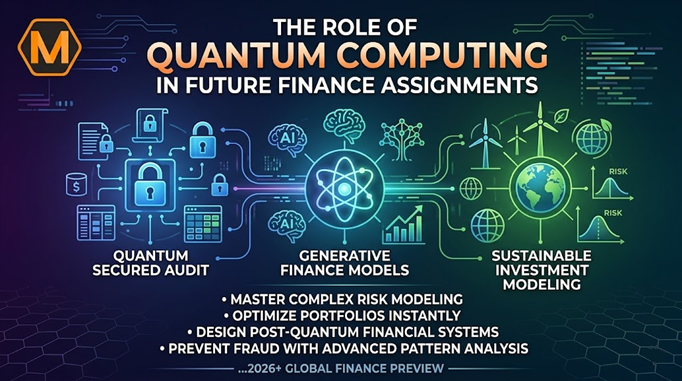
The world of finance is standing on the edge of a massive shift. For decades, banks and investment firms have relied on “classical” computers—the kind we use every day—to calculate risk and manage trillions of dollars. However, as global markets become more complex, these machines are reaching their limits. Enter quantum computing. This technology doesn’t just work faster; it works differently, using the principles of quantum physics to solve problems that would take a traditional supercomputer thousands of years to crack. For students today, understanding this shift isn’t just an elective choice; it is becoming a core requirement for future success in the industry.
As these advanced technologies integrate into university curricula, the difficulty level of coursework is rising sharply. Students are now expected to understand how qubits and quantum algorithms apply to real-world banking. Because these concepts are so new and technically demanding, many researchers find that seeking professional Assignment Help from experts at myassignmenthelp provides the necessary clarity to bridge the gap between abstract physics and practical financial modeling. This transition from traditional spreadsheets to quantum-driven data is redefining what it means to be a finance professional in 2026.
Understanding the Quantum Leap: Beyond Bits and Bytes
To understand why quantum computing is such a big deal for finance assignments, we first have to look at the “bit.” A standard computer uses bits, which are like light switches—they are either On (1) or Off (0). A quantum computer uses “qubits,” which can exist in multiple states at the same time. Imagine spinning a coin on a table; while it’s spinning, it is both heads and tails simultaneously. This is called superposition.
In the context of a finance project, this means a computer can analyze every possible fluctuation in the stock market at the exact same moment. Instead of checking one path at a time, it checks every path at once. For a student tasked with predicting market volatility, this technology changes the entire scope of their research. You are no longer just looking at historical data; you are calculating infinite futures.
Why Traditional Finance is Evolving
Before we dive deeper into the technical assignments, it is helpful to compare the two worlds. Most 12th-grade students are familiar with basic accounting, but quantum finance requires a leap into “probabilistic” thinking.
| Feature | Classical Finance | Quantum Finance (2026+) |
| Data Processing | Linear (One by one) | Parallel (Simultaneous) |
| Risk Modeling | Historical Trends | Real-Time Probabilities |
| Security | Standard Encryption | Post-Quantum Cryptography |
| Optimization | Approximation | Absolute Precision |
| Speed | Minutes to Hours | Seconds to Milliseconds |
Portfolio Optimization and the Power of Algorithms
One of the most common topics in modern finance assignments is “Portfolio Optimization.” This is the art of picking the right mix of stocks, bonds, and assets to get the highest return with the lowest risk. In the past, this was done using something called the Monte Carlo simulation—a method of repeated random sampling to reach a result. While effective, it is slow and often imprecise when dealing with millions of variables.
Quantum algorithms, such as the Quantum Approximate Optimization Algorithm (QAOA), are designed specifically to handle these “needle in a haystack” problems. When writing a paper on this, you have to explain how these algorithms can re-balance a global investment fund in seconds. It allows for a level of precision that was previously impossible. This is why “Quantum Fintech” is becoming a trending keyword in academic circles; it represents the marriage of high-level math and high-stakes banking.
Risk Management in a Post-Quantum World
Risk management is the backbone of the banking system. Banks need to know exactly how much money they might lose if a housing market crashes or a currency devalues. Currently, risk assessment models are “reactive”—they look at what happened yesterday to guess what happens tomorrow. Quantum computing allows for “proactive” modeling. It can simulate complex “Black Swan” events (rare and unpredictable occurrences) with startling accuracy.
However, this power comes with a catch: security. Most of our current banking security relies on encryption that is easy for a quantum computer to break. This has led to the rise of “Post-Quantum Cryptography.” Students focusing on the intersection of law, ethics, and finance are now exploring how regulations must change to protect global wealth from quantum-enabled hacking. If you are struggling with the technicalities of these new security protocols, obtaining specialized Accounting Assignment Help can ensure your analysis of financial statements and audit risks remains accurate and professionally structured.
Why Finance Students are Pivoting to Quantum Research
The job market is already reacting to these changes. Major firms like JPMorgan Chase and Goldman Sachs are hiring “Quantum Researchers” to stay ahead of the curve. Consequently, university assignments are shifting away from simple ledger entries and moving toward algorithmic literacy. A student who can explain how “Quantum Supremacy” affects high-frequency trading is far more valuable than one who only knows traditional accounting.
This shift requires a new kind of “Information Gain” in academic writing. To rank well in your class or on a public blog, you cannot just repeat definitions. You must provide unique insights into how these machines will change the everyday life of a bank teller or a hedge fund manager. It is about connecting the “how” of the technology to the “why” of the economy.
The Impact on Global Economic Stability
One of the most profound areas for students to explore is how quantum computing might prevent global financial crises. By processing massive amounts of data from diverse sources—social media sentiment, weather patterns, and shipping logs—quantum systems can identify “cracks” in the economy before they become visible to human analysts.
For a college assignment, a great case study would be comparing the 2008 financial crisis to a hypothetical “Quantum-Monitored” 2026 economy. Would the algorithms have flagged the subprime mortgage risk earlier? Most experts say yes. This makes quantum computing not just a tool for profit, but a tool for global stability.
The Educational “Skills Gap”
As we move toward this high-tech future, many students feel left behind. The math required for quantum mechanics—linear algebra and complex probability—is often much harder than what is taught in standard business schools. This is why we are seeing a rise in “Hybrid Degrees” that combine Computer Science with Finance.
For those currently in school, the challenge is finding time to learn these new systems while keeping up with current deadlines. This is where professional guidance becomes essential. Understanding the “Logic Gates” of a quantum processor is a world away from balancing a balance sheet, yet tomorrow’s CFOs will need to do both.
The Future of Fintech: Trends to Watch in 2026

As we move further into 2026, we are seeing three major trends that will dominate future finance assignments:
- Real-Time Fraud Detection: Using quantum sensing to spot irregular patterns in global transactions before they even happen.
- Generative Finance: AI agents powered by quantum backends that create personalized investment strategies for individual retail investors.
- Climate Finance: Using quantum simulations to calculate the financial risk of climate change on a city-by-city basis.
These topics are complex because they are interdisciplinary. They require knowledge of environmental science, computer programming, and macroeconomics. For a 12th-grade student or a first-year undergraduate, this can feel overwhelming. The key is to break it down: Quantum is the tool, but Finance is still the goal.
Ethical Considerations in Quantum Banking
With great power comes great responsibility. If one bank gains “Quantum Supremacy” before others, they could theoretically manipulate markets or break the encryption of their competitors. Students are now being asked to write about the “Ethics of Speed.” Should there be laws that limit how fast a quantum computer can trade? Should there be a “Global Quantum Treaty” to ensure fair access to this technology? These are the questions that will define the next decade of academic research in the field.
Conclusion: Preparing for the Quantum Era
The role of quantum computing in future finance assignments is not just about faster math; it is about a new way of thinking. It forces us to move away from certainties and start thinking in probabilities. For the modern student, the challenge is to stay updated. The theories being taught today might be replaced by new quantum discoveries by the time you graduate.
Frequently Asked Question
How does quantum computing differ from classical computing in finance?
Traditional computers process data in a linear sequence, whereas quantum systems use specialized units called qubits to perform multiple calculations at the same time. This allows for near-instant analysis of complex financial models that would otherwise take years to solve.
Will quantum technology make traditional accounting obsolete?
No, but it will transform the tools used in the industry. It is designed to automate the most labor-intensive parts of audit and risk assessment, allowing professionals to focus more on high-level strategy and ethical decision-making.
What is “Quantum Supremacy” in a banking context?
This refers to the milestone where a quantum processor performs a specific financial calculation that is impossible for even the world’s most powerful supercomputer to complete. This breakthrough is expected to revolutionize areas like high-frequency trading.
Is it difficult for students to learn quantum finance?
It is a challenging field because it requires a blend of advanced physics and economic theory. However, focusing on how these algorithms solve real-world optimization problems helps bridge the gap between theoretical science and practical application.
About The Author
Alexander Anderson is a dedicated content strategist and academic consultant at MyAssignmentHelp. With a passion for simplifying complex subjects, he specializes in creating high-quality educational resources that empower students to achieve their full potential. When he isn’t collaborating with his editorial team, Alexander enjoys exploring the latest trends in digital learning and educational technology.
