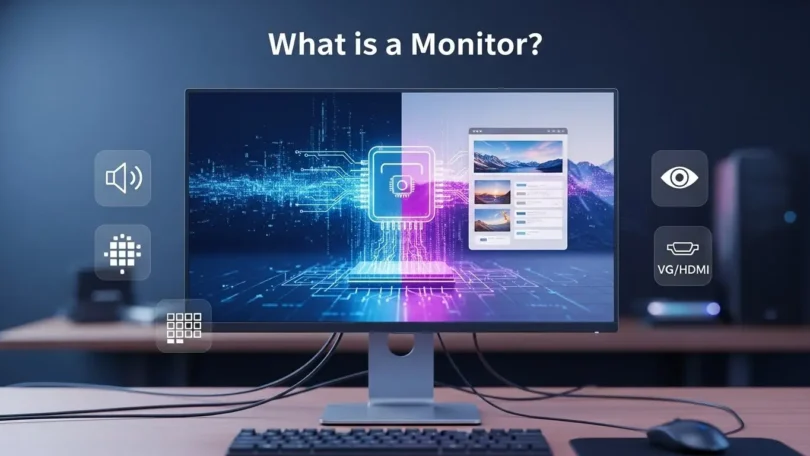
What is Monitor is a special screen that shows everything from your computer. It is like a window where you can see pictures, videos, games, and words from your computer. Without a monitor, it would be impossible to know what your computer is doing. Monitors come in different shapes and sizes, and they help us work, study, and have fun every day.
History of What is Monitor
The story of monitors began many years ago with the old CRT (Cathode Ray Tube) screens. These were big, heavy, and used a lot of electricity, but they helped people see computers for the first time. Later, LCD (Liquid Crystal Display) monitors were invented. They were much lighter, thinner, and clearer than CRTs. Then came LED (Light Emitting Diode) screens, which used less power and showed brighter, sharper pictures.
Types of Monitors
Monitors come in different types, and each type has its own features and uses.
- CRT (Cathode Ray Tube) Monitor: The old style, heavy monitors. They are large but were common in early computers.
- LCD (Liquid Crystal Display) Monitor: Slim, lightweight, and uses less electricity. Shows clear images.
- LED (Light Emitting Diode) Monitor: Brighter, sharper, and more energy-efficient than LCD.
- OLED (Organic LED) Monitor: Offers amazing colors and deep blacks. Great for movies and games.
- Curved Monitor: Wraps slightly around your eyes for a better viewing experience. Good for gaming and work.
Each monitor type has its own advantages, and choosing the right one depends on what you need it for.
Monitor Sizes and Resolutions
Monitors come in different sizes and resolutions, which affect how clear and big things look on the screen.
- Screen Size: Measured in inches diagonally from one corner to the opposite corner. Common sizes: 19”, 24”, 27”, and 32”.
- Resolution: Shows how many tiny dots (pixels) make up the image. Higher resolution means sharper and clearer images. Examples: 1080p (Full HD), 1440p (2K), 2160p (4K).
- Aspect Ratio: The width-to-height ratio of the screen, like 16:9 (widescreen) or 21:9 (ultrawide).
- Effect on Viewing: Bigger size and higher resolution give more details and better experience for work, movies, or gaming.
Choosing the right size and resolution is important to see clear images and enjoy using your monitor comfortably.
Monitor Components
A monitor is made up of several important parts that work together to show clear images and videos.
- Screen Panel: The main part where images and videos appear. Can be LCD, LED, or OLED.
- Backlight: Provides light behind the screen so images are bright and visible.
- Ports: Connect the monitor to a computer or other devices. Common types: HDMI, VGA, DisplayPort, USB.
- Stand/Base: Holds the monitor upright. Some stands are adjustable for height, tilt, and rotation.
- Control Buttons: Usually on the side or bottom, for adjusting brightness, contrast, and settings.
- Speakers (Optional): Some monitors have built-in speakers for audio.
Every component plays an important role, and together they make your monitor work perfectly for work, study, and entertainment.
How a Monitor Works
A monitor works by receiving signals from the computer and turning them into images and videos that we can see.
- Signal from Computer: The computer sends video data through cables like HDMI, VGA, or DisplayPort.
- Processing the Signal: The monitor’s internal circuit board reads the signal and prepares it for display.
- Lighting the Screen: The backlight lights up the screen so the image can be seen clearly.
- Displaying Pixels: Tiny dots called pixels light up in different colors to form images, text, and videos.
- Refreshing the Screen: The monitor updates the images many times per second (refresh rate) to make motion smooth.
Monitors turn digital signals into visible images step by step, letting us interact with computers in a clear and smooth way.
Common Features of Monitors
Monitors come with different features that make using them easier and more enjoyable.
- Refresh Rate: Shows how many times the screen updates per second (measured in Hz). Higher refresh rate makes motion smoother, especially in games.
- Brightness: How bright the screen can get. Brighter screens are easier to see in sunlight or bright rooms.
- Contrast Ratio: Difference between the darkest and brightest parts of the screen. Higher contrast shows clearer images.
- Color Accuracy: How true the colors appear on the screen. Important for designers, photographers, and video editors.
- Viewing Angles: How well the screen can be seen from different positions without colors changing.
- Touchscreen (Optional): Some monitors let you touch the screen to control the computer.
These features improve your viewing experience, making monitors more useful for work, study, gaming, and entertainment.
Choosing the Right Monitor
Choosing the right monitor depends on what you need it for and how you plan to use it.
- Purpose/Usage: Decide if you need it for gaming, work, studying, or watching movies. Different uses need different features.
- Screen Size: Bigger screens are better for multitasking and movies; smaller screens are good for limited spaces.
- Resolution: Higher resolution (like 2K or 4K) gives sharper images, while lower resolution is cheaper.
- Refresh Rate: Gamers should look for higher refresh rates (120Hz or more) for smooth motion.
- Budget: Consider your budget. More features often cost more.
- Ports and Compatibility: Check if the monitor has HDMI, DisplayPort, or USB ports to connect to your devices.
Choosing the right monitor means balancing your needs, budget, and features to get the best experience for your tasks.
Caring for Your Monitor
Taking care of your monitor helps it last longer and stay bright and clear.
- Keep it Clean: Use a soft, dry cloth or screen cleaner to remove dust and fingerprints gently.
- Avoid Scratches: Do not press hard on the screen or use rough materials.
- Proper Placement: Keep the monitor on a flat surface and avoid direct sunlight to protect the screen.
- Adjust Brightness and Contrast: Use proper settings to reduce eye strain and save energy.
- Turn Off When Not in Use: Switching off your monitor when not needed saves electricity and extends its life.
- Avoid Overheating: Make sure vents are not blocked and there is enough space around the monitor for airflow.
Simple care and proper use can make your monitor last longer and give the best viewing experience every day.
Future of Monitors
Monitors are constantly improving, and new technologies will make them even better in the coming years.
- 4K and 8K Resolution: Screens with ultra-high resolution for super clear images and videos.
- Curved and Flexible Screens: Monitors that wrap around your eyes or can be bent for new experiences.
- OLED and Quantum Dot Technology: Brighter colors, deeper blacks, and better energy efficiency.
- Touch and Gesture Controls: Using hands or gestures to control the monitor without a keyboard or mouse.
- Wireless Monitors: Screens that connect to computers and devices without cables.
- Eco-Friendly and Energy-Saving: Monitors designed to use less electricity and last longer.
The future of monitors will be brighter, sharper, and more interactive, making work, learning, and gaming even more exciting.
Common FAQs About Monitors
Some FAQs of Monitors:
Can I use a monitor without a computer?
Some monitors can connect to smartphones, tablets, or gaming consoles, but most need a computer to work.
What is the difference between a monitor and a TV?
Monitors are designed for close-up work with high resolution and fast response, while TVs are made for watching shows from far away.
Why do some monitors flicker?
Flickering can happen if the refresh rate is too low or the monitor cable is loose. Adjusting settings or replacing the cable usually helps.
Can monitors affect eye health?
Yes, staring at screens for too long can cause eye strain. Using proper brightness, breaks, and blue light filters helps protect your eyes.
What is a curved monitor good for?
Curved monitors give a wider and more natural view, making games and movies more immersive.
Do monitors use a lot of electricity?
Modern LED and OLED monitors are energy-efficient and use much less electricity than old CRT monitors.
Can I connect multiple monitors to one computer?
Yes, many computers allow dual or triple monitors for more workspace or better multitasking.
What is a touch monitor?
A touch monitor lets you control the computer by tapping, swiping, or drawing directly on the screen.
How long do monitors usually last?
Most monitors last 5–10 years, depending on usage, care, and technology quality.
Are gaming monitors different from regular monitors?
Yes, gaming monitors usually have higher refresh rates, faster response times, and better color accuracy for smoother gameplay.
Conclusion
Monitors are more than just screens they are the bridge between us and the digital world. Modern monitors now come with smart features like built-in speakers, blue light filters, and adjustable stands to improve comfort and productivity. Some even support wireless connections, curved designs, and ultra wide screens for a more immersive experience.
By understanding the different types, sizes, and features, anyone can choose a monitor that fits their needs perfectly. With proper care, your monitor can stay bright, clear, and useful for many years, making everyday computer use easier and more enjoyable.